Choosing the right cooking appliance can significantly impact both efficiency and energy consumption in the kitchen. Recent studies indicate that induction hobs are becoming increasingly popular due to their efficiency. According to the U.S. Department of Energy, induction cooking uses around 90% of the heat generated directly in the pan. In contrast, gas stoves typically operate at about 40% efficiency. This raises the question: Why are induction hobs more energy efficient than gas stoves?
Induction hobs also provide quicker cooking times. Research from the Energy Saving Trust reveals that they heat up about twice as fast as gas stoves. This means less waiting time and reduced energy use. Additionally, due to their reliance on electrical energy, induction hobs align better with renewable energy sources. As more households switch to green electricity, the carbon footprint of cooking continues to shrink.
However, user experience can vary. Induction hobs require compatible cookware, which may involve additional costs. Some cooks may miss the visual control of a flame, affecting their cooking style. It is essential to weigh these factors carefully when deciding between induction and gas. Understanding the nuances of each appliance can lead to a more informed choice for efficiency-minded consumers.
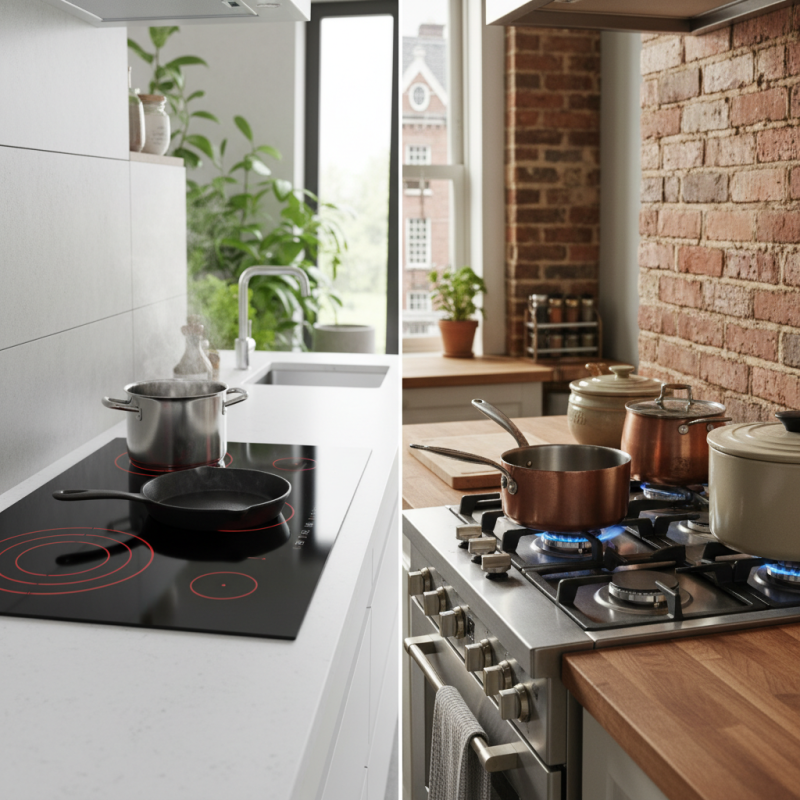
When considering energy efficiency, induction hobs and gas stoves present unique benefits. Induction hobs use electromagnetic energy to heat pots directly, resulting in less wasted energy. According to the U.S. Department of Energy, induction cooking is about 84% efficient, compared to 40% for gas. This means more energy is used for cooking rather than lost to the environment.
Gas stoves, while popular for their immediate heat, have some downsides. They account for about 20% of a household's total energy consumption. Cooking with gas can lead to heat loss, and the combustion process can produce greenhouse gases. A report by the International Energy Agency showed that over time, this contributes to overall inefficiency. Additionally, gas leaks can be a concern, highlighting hidden energy losses.
Choosing between these cooking methods is nuanced. Induction cooking may save energy but requires specific cookware. Gas stoves can be less efficient but offer flexibility during power outages. Home cooks must weigh these factors, considering both efficiency and personal cooking preferences.
| Feature | Induction Hobs | Gas Stoves |
|---|---|---|
| Energy Efficiency | 85-90% | 40-60% |
| Heat Control | Instantaneous & Precise | Varies, Slower Response |
| Safety | Lower risk of burns, cool to touch | Higher risk of burns and gas leaks |
| Installation Cost | Higher upfront cost | Generally lower upfront cost |
| Ease of Cleaning | Smooth surface, easy to clean | Can be difficult due to grates & spills |
| Cooking Style | Ideal for fast cooking & simmering | Good for a variety of cooking techniques |
: Induction hobs are about 84% efficient, while gas stoves have an efficiency of 40%.
Gas stoves account for about 20% of household energy use and lose heat during combustion.
Induction hobs can boil water in less than five minutes. Gas takes over nine minutes.
Induction hobs are quieter. Gas stoves produce noise from flames and combustion.
Induction hobs range from $600 to $1,200, while gas stoves vary from $400 to $1,500.
Yes, gas leaks can contribute to energy loss in homes.
Yes, using induction requires compatible cookware, which can increase upfront costs.
Households may save up to $100 annually by switching to induction, depending on usage.
Some chefs like gas for its visible flame, which offers a sense of control while cooking.
Users may face an adjustment period and can miss the familiarity of cooking with gas.
When considering the efficiency of cooking appliances, a comparison between induction hobs and gas stoves reveals significant differences. Induction hobs are often deemed more energy efficient than gas stoves due to their method of heat generation, which directly heats the cookware through electromagnetic fields, resulting in minimal energy loss. This precise transfer of energy not only enhances cooking speed but also reduces overall energy consumption, leading to lower utility bills in the long run.
Moreover, an analysis of heat transfer rates shows that induction cooking provides faster and more uniform heating compared to gas, which can waste heat and energy. Safety features play a crucial role as well, with induction hobs offering reduced burn risks and lower carbon emissions, thus contributing positively to environmental sustainability. Overall, the combination of long-term energy savings and reduced environmental impact positions induction hobs as a superior choice for efficient cooking.

 Invito Furniture